
 |
Fully remote work is taking a nosedive in popularity among both communications leaders and CEOs, and while hybrid is leading the way, fully in-person workplaces are making a surprising comeback in executive suites.
That’s one of the conclusions of the 3rd Annual Harris X & Ragan Survey of Communications Leaders, which also asked 173 CEOs and 197 communications leaders (CCOs, CMOs & SVP/VPs) their takes on such workplace issues as artificial intelligence in the workplace.
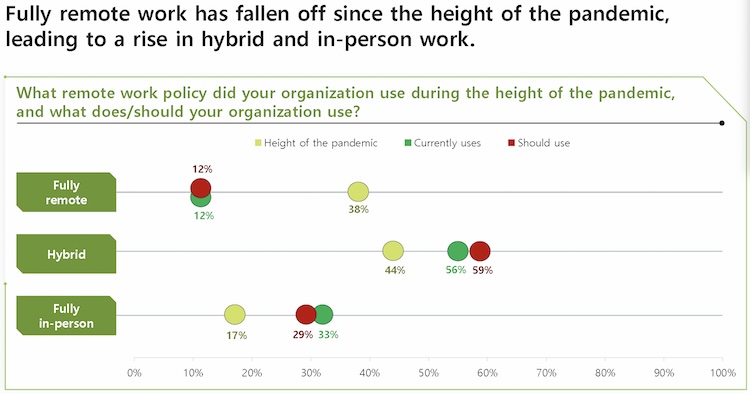
While 38 percent of respondents said that their organizations opted for fully remote work at the height of the pandemic, that number dropped to 12 percent by the time the survey was conducted (Aug. 11 – Sept. 11). In addition, an equally paltry 12 percent said that they thought their company should be operating on a fully remote basis.
While the use of a hybrid workplace rose from 44 percent of respondents during the pandemic to 56 percent in this year’s study, fully in-person work also took a surprising jump, going from 17 percent to 33 percent.
 |
Small organizations seemed to be the most likely to hold on to the idea of remote working, with 35 percent saying that they depend on “mostly remote” work, considerably above the 27 percent of large organizations and 19 percent of medium organizations that said the same. In addition, medium and large companies (44 percent) both said they were far more likely to use a “mostly in-person” workforce than small companies (34 percent) were.
As regards the use of artificial intelligence, more than four out of five (82 percent) of the CEOs surveyed said they had a favorable view of AI and nearly as many of the comms leaders (78 percent) agreed. A large majority of respondents (86 percent of CEOs, 91 percent of comm leaders) also reported being knowledgeable about AI.
Few respondents saw AI as a threat to their livelihood. Only 16 percent of CEOs and 13 percent of other comms leaders said they “worry that AI will replace my job someday,” with 64 percent of CEOs and 75 percent of comms leaders noting that AI “will enhance my capabilities to do my job effectively and efficiently.”
Far and away the most popular AI tool was ChatGPT, with 44 percent of respondents saying they use the platform to write emails, 41 percent employing it to summarize articles or other documents and 34 percent putting it to work writing press releases.
The survey also looked at how much trust comms leaders place in their CEOs in several areas. While trust levels have slid slightly since last year’s survey, they still clock in at 91 percent for external communications, 89 percent for internal/employee commnications and 89 percent for DE&I.

 Consumers who once demanded convenience now require consistent, multi-channel experiences that cater to them at every point. Brands must have a clear, audience-appropriate, and channel-specific voice across all platforms.
 Employees at U.S. companies are experiencing high levels of burnout, but managers are lagging behind when it comes to their awareness of the problem
 Brand has a powerful effect on a company’s valuation, but the level of brand understanding in the investment community leaves a lot to be desired, according to a new study from Brodeur Partners, Interbrand and NewtonX.
 AI may still be viewed with a wary eye by most media pros, but its use is growing, according to a new study from Muck Rack.
 A new study from Walker Sands says that some marketers have been putting the cart before the horse when it comes to the relationship between marketing channels and business outcomes.


 Have a comment? Send it to
No comments have been submitted for this story yet.