
 |
CEOs are taking a step back from CSR, DEI and ESG to put an increased emphasis on the bottom line, according to a new study from Boathouse, and that’s changing what they expect from—and how they rate—their marketing staffs and CMOs.
Financial performance, AI, security/privacy and cost cutting are moving to the top of the priority heap, with the result that majority of CEOs who responded to the Boathouse study are negotiating an environment in which the goal posts keep shifting. More than half of the 150 CEOs who responded to the study reported that their job is more complicated than it was in the past.
But that number is a big drop from the 93 percent who said their jobs were getting more complicated in the 2021/2022 edition of the Boathouse study. That decline may be a least partly due to the fact that CEOs are just getting used to a business climate where everything keeps shifting. More than six in 10 (61 percent) of the CEOs surveyed said they were prepared to handle a daunting range of issues and stakeholders when they took the reins.
 |
That increased comfort level seems to also be leading to an increased sense of trust between top execs and top marketers. In the new study, 49 percent of CEOs rate their company’s marketing “best in class,” with 40 percent giving their CMO the same ranking. In 2021, those numbers were 20 percent and 21 percent respectively. Almost a third of the surveyed CEOs (31 percent) said that their marketing staff performed “above my expectations.”
On the other side, the number of “underperformers” took a healthy drop, going from 24 percent in 2021 to 11 percent in 2023.
Overall, respondents said that 87 percent of their CMOs “understand their vision and take acton to execute that vision." Plus, almost three-quarters (73 percent) of the CMOs are credited with being “bold” and “pushing the organization.”
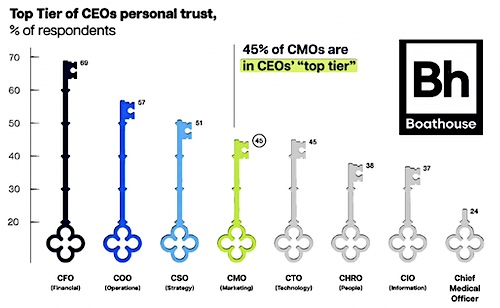
CMOs have also become one the C-suite’s most trusted partners, with 45 percent ranking “in the top tier” as regards trust. There is also a higher view of CMO loyalty, with 8 in 10 CEOs saying that they think their CMO “would take a bullet for them.”
However, that trust does not seem to carry over into personal relationships. When ranked by such categories as “is easy to collaborate with,” “shares my value” and “puts my needs before their own,” in six out of ten of those scores have declined.
CEOs do see their CMOs as being up to speed on AI. Nine out of ten (90 percent) believe that CMOs are “tackling AI in service of the company’s marketing performance” and 58 percent “have made AI presentations, asked for funding or created new processes using AI.”

 Consumers who once demanded convenience now require consistent, multi-channel experiences that cater to them at every point. Brands must have a clear, audience-appropriate, and channel-specific voice across all platforms.
 Employees at U.S. companies are experiencing high levels of burnout, but managers are lagging behind when it comes to their awareness of the problem
 Brand has a powerful effect on a company’s valuation, but the level of brand understanding in the investment community leaves a lot to be desired, according to a new study from Brodeur Partners, Interbrand and NewtonX.
 AI may still be viewed with a wary eye by most media pros, but its use is growing, according to a new study from Muck Rack.
 A new study from Walker Sands says that some marketers have been putting the cart before the horse when it comes to the relationship between marketing channels and business outcomes.


 Have a comment? Send it to
No comments have been submitted for this story yet.