
The coronavirus (COVID-19) pandemic has driven a strong increase in digital news consumption, resulting in a rise in digital subscriptions and potentially offsetting at least some of the damage from the dwindling ad revenues and single-copy sales slumps that have hammered the publishing industry this month, according to a new study by business management consultancy Mather Economics.
Publishers’ digital subscription volumes accelerated over the last month, according to the study, resulting in total average circulation growth of 3.3 percent.
Total print volumes, meanwhile, were down .89 percent for the same period.
The study found the largest digital publishers (those with more than 25,000 subscribers) have witnessed the sharpest circulation percentage growth over the previous month, at 5.8 percent.
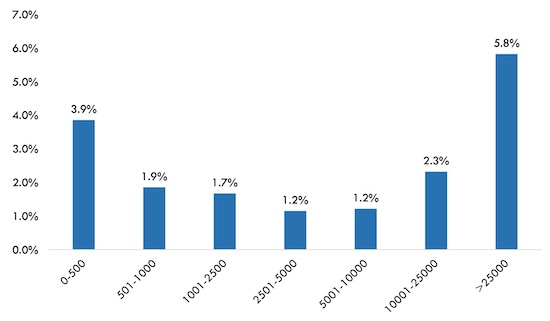 The largest digital publishers have experienced the sharpest percentage growth in circulation over the last month. The smallest digital publishers have also grown significantly. The largest digital publishers have experienced the sharpest percentage growth in circulation over the last month. The smallest digital publishers have also grown significantly. |
Small digital publishers (those with up to 500 subscribers) also grew significantly during that period (up 3.9 percent). Publishers in the middle (between 2,501 and 10,000 subscribers) experienced the smallest gains, at 1.2 percent.
The largest digital publishers also boasted the highest average month-over-month retention (96 percent) as well as the highest average weekly subscription rates ($2.62). Interestingly, those with the smallest digital subscribers also had the the second-highest retention rates (95.9 percent) and the second-highest average subscription rates ($2.14). Publishers with digital circulation sizes between 1,000 and 2,500 had the lowest retention rates as well as the lowest average weekly subscription rates.
U.S. newspapers have increased investments in digital subscriptions by 52 percent since the same period last year, according to the study. As a result, publishers’ share of digital subscribers as a percentage of their total circulation has grown to 24.3 percent this year, compared to 9.3 percent in 2019.
Mather Economics’ study, “COVID-19: Early Subscription Insights & Considerations for Business Continuity,” analyzed the subscriber data of nearly 200 partner publishers between February 24 and March 23.

 Fox Corp. reports fiscal Q3 revenues plummeted 15.4 percent to $3.4B from the year ago period that included the broadcast of advertising-rich Super Bowl LVII.
 Trump Media & Technology Group today reported a $58.2M net loss on $4.1M in 2023 revenues, a disclosure that drove its stock price down 22.6 percent to $47.96.
 Barry Pollack, an attorney at Wall Street’s Harris St. Laurent & Wechsler, has registered Julian Assange as a client with the Justice Dept. “out of an abundance of caution.”
 Paramount Global to slash 800 jobs in what chief executive Bob Bakish calls part of an effort to “return the company to earnings growth"... Rolling Stone editor-in-chief Noah Shachtman is exiting at the end of the month due to disagreements with chief executive Gus Wenner over the direction the magazine is taking... The New York Times broke the $1 billion barrier in annual revenue from digital subscriptions in 2023... Press Forward is investing more than $500 million to strengthen local newsrooms.
 The majority of news articles are read within the first three days of publication, according to a recent report.


 Have a comment? Send it to
No comments have been submitted for this story yet.