
Chief marketing officers are quickly adopting generative AI technologies for an increasing number of tasks, according to an annual survey by global digital network Dentsu Creative.
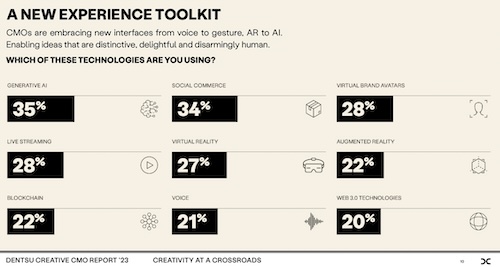
The survey, which polled CMOs on the challenges and opportunities facing the marketing landscape today, found that more than a third (35 percent) of CMOs are now using generative AI as part of their everyday toolkits. Other new technologies being adopted by CMOs include social commerce (34 percent), live-streaming (28 percent), virtual brand avatars (28 percent), virtual reality (27 percent), augmented reality (22 percent), blockchain (22 percent), voice (21 percent) and Web 3.0 (20 percent).
An additional 26 percent of marketers reported that they intend to adopt generative AI technologies soon.
 |
Marketers appear to be generally positive about the rise of generative AI and its potential uses in the industry: 87 percent said they believe that generative AI represents the future of advertising and marketing, with 86 percent claiming that AI will improve efficiency and 83 percent saying that AI will enable human teams to take on more creative tasks.
But with change comes inevitable concerns. More than half (57 percent) of the marketers surveyed expressed worry that generative AI might take their jobs, and an even larger number (61 percent) of respondents believe that generative AI will impact society for the worse.
Additionally, there’s the ever-present criticism that AI will never be a substitute for the human touch that’s integral to all communications. More than three-quarters (77 percent) of marketers believe that AI will never create content that truly moves them, and 75 percent additionally said that generative AI will never fully replace the essence of human creativity. Then there’s the consensus that people will always prefer content created by other people: an overwhelming 81 percent said they think customers will always pay a premium for human-created content.
Finally, the survey found that more than half (60 percent) of CMOs believe that the industry doesn’t currently take enough creative risks.
Dentsu Creative’s report surveyed 700 CMOs and senior marketers in the U.S., UK, Australia, Brazil, Canada, India, Italy and Spain. Surveys were conducted in May.

 Thanks to advances in AI, social media has now taken a leading role in providing customer support services for brands, with adoption achieving noted fanfare among Gen Z consumers.
 Why universities must offer Communications Engineering degrees in the AI-driven world.
 The Windy City is bullish on AI, according to a recent survey conducted by the Communications Leaders of Chicago in conjunction with DePaul University’s College of Communication.
 The emergence of generative artificial intelligence (Gen AI) technology is a curveball that has the potential to significantly disrupt and erode voter trust in the media and governmental leadership.
 The process of conducting searches is being transformed by generative AI, which is now embedded within search engines such as Bing, Perplexity, and Google's Search Generative Experience.


 Have a comment? Send it to
No comments have been submitted for this story yet.