
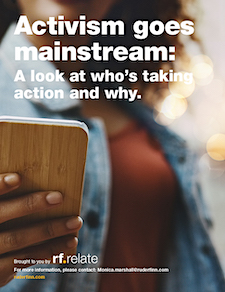
Activism is becoming a regular activity for an increasing number of Americans, and that has a ripple effect on how they view a company’s activities and behavior, according to a study from Ruder Finn.
More than half (53 percent) of the almost 9,000 people surveyed for the study said they have taken actions to support a social issue in the past six months. For many of them, the level of commitment was even greater, with 13 percent saying they took such actions once a month, nine percent saying they did so several times a month, and four percent each saying they got involved once a week, a few times a week or daily.
 |
And it’s not Millennials or GenXers who are the biggest fuelers of this trend. Almost a third (30 percent) of respondents age 34-49 said they were active in supporting a social issue, with the 50-64 age bracket following at 27 percent. Millennials lagged behind at 21 percent, trailed by Gen Zers at nine percent.
Companies are taking a big part in how that activism is being carried out, the study found. While social media (31 percent) or news stories (26 percent) were the biggest influencers on actions, 25 percent were most influenced by either a company they work for or one that they like. Friends and family came in at 21 percent.
About a third of the actions that people took were related to a company, with half of them supporting a company whose social stance the respondent agreed with by either purchasing its products or sharing information about it. Nearly the same number went in the other direction by boycotting or quitting a company whose social stand was at odds with their opinions.
The companies that gained the most support for their stands on issues were Nike, Chick-fil-A, Apple, Amazon and Patagonia.
A negative reaction to a company’s social stance, however, need not be permanent. Almost three-quarters of respondents said they would forgive a company for its stand if a company executive explained why that stand was important, if they could see how that stance was related to a company’s products and services, or if they believed the stance was an essential part of the company’s history, with its employees being on board.
What matters most when a company is trying to make a case for its social stance with consumers? Authenticity. Respondents said that companies should be truly invested in the causes they support, rather than just taking a stance as a result of external pressures.
“Activism Goes Mainstream” was based on a 10-question online survey conducted from Oct. 2-7.

 Consumers who once demanded convenience now require consistent, multi-channel experiences that cater to them at every point. Brands must have a clear, audience-appropriate, and channel-specific voice across all platforms.
 Employees at U.S. companies are experiencing high levels of burnout, but managers are lagging behind when it comes to their awareness of the problem
 Brand has a powerful effect on a company’s valuation, but the level of brand understanding in the investment community leaves a lot to be desired, according to a new study from Brodeur Partners, Interbrand and NewtonX.
 AI may still be viewed with a wary eye by most media pros, but its use is growing, according to a new study from Muck Rack.
 A new study from Walker Sands says that some marketers have been putting the cart before the horse when it comes to the relationship between marketing channels and business outcomes.

 Have a comment? Send it to
No comments have been submitted for this story yet.