
 |
Consumers want to be heard by companies—even if their opinions are at odds. That’s the conclusion of “Collaboration & Consensus: Do Consumers Feel Heard?”, a new survey conducted by Ruder Finn.
More than four in ten of the survey respondents (43 percent) said that as long as a brand “demonstrated that it heard their point of view,” they would feel that the brand had listened to them, even if it wound up taking a stance on an issue that disagreed with their own. When the brand failed to give an explanation, however, only 19 percent of respondents said that they would feel listened to if they were on the opposite side of an issue.
There was also broad agreement from respondents (93 percent) that brands should react to public opinion.
Overall, many consumers are taking an active role in their interactions with brands. More than half (57 percent) said they actively engage with brands either through online commenting or direct outreach.
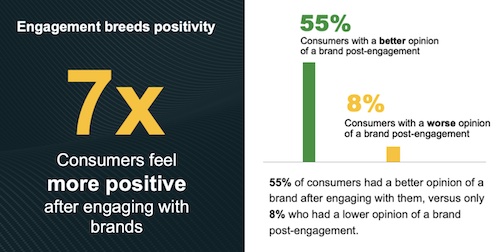
For many of them, that sense of engagement translated to an improved relationship with the brand. More than half (55 percent) noted that they had “a better opinion of a brand” after engaging with them, as opposed to just 8 percent saying that their opinion of the brand went down after the interaction.
 |
There are obstacles to engagement, however. Only about 1 in 2 say it’s easy to contact brands, with 38 percent of Gen Z saying it’s easy to contact brands compared to 53 percent of Millennials and 58 percent of Gen Xers.
“The results of our latest survey indicate the importance of an empathetic leadership style that demonstrates listening when engaging today’s consumer,” said Ruder Finn CEO Kathy Bloomgarden. “It’s more important to show that you’re listening than it is to speak out. This has significant implications for today’s leadership style and determining how leaders engage with groups with different opinions.”
The survey polled 1,000 US consumers ages 16 and above, who were surveyed on Dec. 19 and 20, 2022.

 Consumers who once demanded convenience now require consistent, multi-channel experiences that cater to them at every point. Brands must have a clear, audience-appropriate, and channel-specific voice across all platforms.
 Employees at U.S. companies are experiencing high levels of burnout, but managers are lagging behind when it comes to their awareness of the problem
 Brand has a powerful effect on a company’s valuation, but the level of brand understanding in the investment community leaves a lot to be desired, according to a new study from Brodeur Partners, Interbrand and NewtonX.
 AI may still be viewed with a wary eye by most media pros, but its use is growing, according to a new study from Muck Rack.
 A new study from Walker Sands says that some marketers have been putting the cart before the horse when it comes to the relationship between marketing channels and business outcomes.


 Have a comment? Send it to
Feb. 15, 2023, by Bill Huey
Only 1 in 2 say it's easy to contact brands? That number should be MUCH higher, like 1 in 8. Just try contacting Microsoft, or Amazon, or AT&T. You can't do it. You might as well try to call the Pope.