
 |
Having an effective presence on digital media can play a big role in helping CEOs manage their companies’ reputations and connect with their employees, a new study from H/Advisors Abernathy finds, but many corporate leaders are failing to take full advantage of the reputational benefits that digital media offers.
Almost a third of the Fortune 100 CEOs in the study (30 percent) do not have any presence on social media. For those who are on social media, LinkedIn is the most popular platform. Almost two-thirds of the CEOs in the study (64 percent) have a profile there. Twitter lags behind with just 32 percent. (The study pre-dates the introduction of Meta’s Threads.)
However, the study says that simply having a profile on a digital platform is not enough. Noting such threats as the possibility of online impersonation, it stresses the importance of verifying and optimizing digital profiles. On LinkedIn, for example, an optimized profile results in a 37 percent jump in likes, shares, clicks and comments.
But once again, it appears that the CEOs have a bit of catching up to do. Fewer than half of those on LinkedIn (48 percent) have optimized their profiles for discovery, while over at Twitter only 12 percent have done so.
 |
It is also key for those who have a social media profile to not just stand on the sidelines. “Our research found that active leaders posted at least once-per-week on social media channels,” the study notes. The benefit: the most active CEOs have engagement rates exceeding that of their peers by “at least two percentage points.”
Other strategies to boost effectiveness include bringing a CEO’s personality into their social media profile and expanding the topics addressed beyond company news.
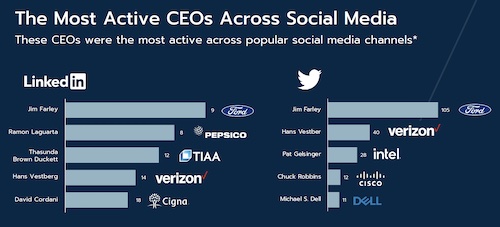
The study also names the most active CEOs on social media. Coming out on top on both LinkedIn and Twitter was Ford CEO Jim Farley, with an average of 125 posts per month—85 percent of those on Twitter. Farley’s Twitter account also includes a clickable company logo, which directs users to the official Ford Twitter account, helping to “establish and bolster brand reputation.”
The most followed CEO on LinkedIn is Microsoft’s Satya Nadella, with an audience of over 10 million. Twitter’s most followed CEO should come as no surprise: Elon Musk, with a follower base of over 124 million.
The best engagement rate on LinkedIn was achieved by Procter & Gamble’s Jon Moeller, with Disney’s Bob Iger having the best engagement rate on Twitter.
The H/Advisors Abernathy study analyzed more than 55,000 posts, focusing on content published between January 1 and November 30 of last year.

 Consumers who once demanded convenience now require consistent, multi-channel experiences that cater to them at every point. Brands must have a clear, audience-appropriate, and channel-specific voice across all platforms.
 Employees at U.S. companies are experiencing high levels of burnout, but managers are lagging behind when it comes to their awareness of the problem
 Brand has a powerful effect on a company’s valuation, but the level of brand understanding in the investment community leaves a lot to be desired, according to a new study from Brodeur Partners, Interbrand and NewtonX.
 AI may still be viewed with a wary eye by most media pros, but its use is growing, according to a new study from Muck Rack.
 A new study from Walker Sands says that some marketers have been putting the cart before the horse when it comes to the relationship between marketing channels and business outcomes.


 Have a comment? Send it to
No comments have been submitted for this story yet.