
 |
PR pros working at brands tend to take home bigger paychecks than those employed by agencies, and the PR field as a whole remains more financially rewarding than journalism, according to a new study from Muck Rack.
The PR pros that took part in the “State of PR and Journalism: Salaries 2023” survey reported an average salary of $85,000, which aligns with the $84,737 found in Census Bureau figures that were collected by Data USA.
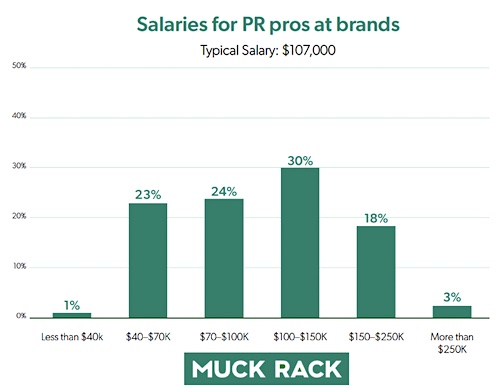
However, those working for brands were paid an average of $107,000, while at agencies, the typical salary was just $80,000. More than half of PR pros at brands (51 percent) said that they made more than $100,000 per year—only 26 percent of those at agencies made that claim.
As would likely be expected, employees with more senior titles were also more likely to have a larger salary. C-suite employees (CCO, CMO, etc.) reported an average salary of $150,000. Those on the director or VP level averaged $120 while managers racked up $87,000 and coordinators were paid an average of $63,000.
 |
But those bigger checks can come with longer hours, it appears. Seventeen percent of C-suite-level respondents said they work 51 or more hours a week. Only seven precent of directors made that claim, and that number dropped to three percent for managers and zero for coordinators.
The picture is not quite so rosy for journalists—only 17 percent of whom top the $100,000 barrier in terms of salary. In addition, close to a quarter of journalists take home less than $40,000 yearly, far below the two percent reported by PR pros at agencies and one percent by those at brands.
Things are even worse for freelance journos, with 35 reporting yearly pay of under $40,000.
Even at the top levels, the gap between PR and journalism still holds. Three percent of PR pros in the survey said they make more than $250,000 per year, while only one percent of journalists say their salaries are at that level.
Muck Rack’s study surveyed 1,034 PR pros between March 31 and April 25 of 2022, and 2,226 journalists between January 4 and February 6 of this year.

 Consumers who once demanded convenience now require consistent, multi-channel experiences that cater to them at every point. Brands must have a clear, audience-appropriate, and channel-specific voice across all platforms.
 Employees at U.S. companies are experiencing high levels of burnout, but managers are lagging behind when it comes to their awareness of the problem
 Brand has a powerful effect on a company’s valuation, but the level of brand understanding in the investment community leaves a lot to be desired, according to a new study from Brodeur Partners, Interbrand and NewtonX.
 AI may still be viewed with a wary eye by most media pros, but its use is growing, according to a new study from Muck Rack.
 A new study from Walker Sands says that some marketers have been putting the cart before the horse when it comes to the relationship between marketing channels and business outcomes.


 Have a comment? Send it to
No comments have been submitted for this story yet.