
 |
Although a wide range of social and personal factors are impacting Gen Z’s relationship with the food they eat, a new study from Ketchum says that a few hot-button topics—sustainability and animal welfare—are having a greater effect on what Gen Z consumers say than on how they actually spend their money on food.
More than three quarters (76 percent) of the 2,000 Gen Zers surveyed by Ketchum said that “sustainability is an important factor” when they are making food purchases. However, far fewer (16 percent) indicated that they actually look for sustainably sourced ingredients on the labels of foods they are considering purchasing.
Similarly, while a large majority (72 percent) say that animal welfare is a factor they consider when making a food purchase, just five percent reported that animal welfare has impacted their eating pattern.
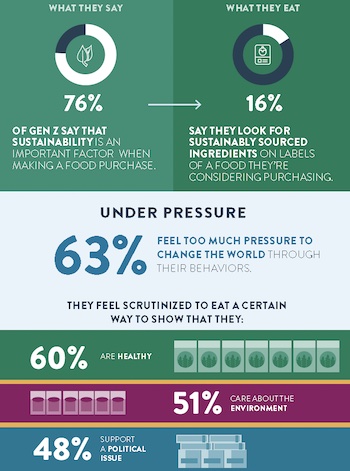 |
The survey respondents also say that they feel burdened by the expectations being placed on them to bring their food purchasing decisions in line with their general opinions about the overall food system. Almost two thirds (63 percent) say they experience “too much pressure to change the world” through their behaviors.
However, that does not mean that Gen Zers are happy with the state of the food system. More than seven in 10 think “food companies are greedy and only care about profits” while almost as many (72 percent) say “the food system is broken.” In addition, 66 percent say that they have trouble finding information about how their food is raised and 42 percent think food companies “don’t understand them.”
A majority of survey respondents are also uneasy about their own eating patterns, with 62 percent saying those patterns are “wrong.” The study also says that Gen Zers are less likely than other generations to say they have a positive relationship with food, and are more likely to say that cooking makes them feel “tired and stressed.”
As regards where they find out about food, 70 percent say they follow influencers for their food content, and the same number say that they are more willing to trust a food trend if it has gone viral. But many also see themselves as influencers, with 75 percent regarding themselves as “a leader, not a follower,” and 76 percent reporting that they tell friends and family about new products.
“This generation has seen food politicized and been taught to choose food products related to values,” said Melissa Kinch, president of Ketchun’s Food Consultancy. “It has left them feeling insecure and negative about cooking and food. In particular, the contrast between what they say and how they spend their money is eye-opening.”
The Ketchum study was conducted between April 7 and 18.

 Consumers who once demanded convenience now require consistent, multi-channel experiences that cater to them at every point. Brands must have a clear, audience-appropriate, and channel-specific voice across all platforms.
 Employees at U.S. companies are experiencing high levels of burnout, but managers are lagging behind when it comes to their awareness of the problem
 Brand has a powerful effect on a company’s valuation, but the level of brand understanding in the investment community leaves a lot to be desired, according to a new study from Brodeur Partners, Interbrand and NewtonX.
 AI may still be viewed with a wary eye by most media pros, but its use is growing, according to a new study from Muck Rack.
 A new study from Walker Sands says that some marketers have been putting the cart before the horse when it comes to the relationship between marketing channels and business outcomes.


 Have a comment? Send it to
No comments have been submitted for this story yet.