
 |
People are spending more time than ever on social media, according to a new study from cloud-based social media management platform Sprout Social, and while a focus on issues and causes may be top of mind for many brands when it comes to social media priorities, that isn’t necessarily the case for many consumers.
In the latest edition of the Sprout Social Index, more than 1,800 consumers and 900 marketers in the US and UK weighed in with their opinions, and more than half of them (53 percent) said that their social media usage “has been higher over the last two years than in the previous two years.”
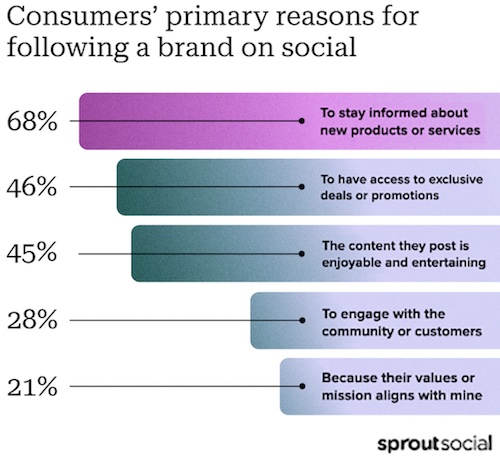
What drives them to follow a brand on social? Only about one in five (21 percent) said “because their values or mission aligns with mine.” Other, more prosaic concerns were considerably more popular. Top of the list: “To stay informed about new products or services,” which was cited by almost seven in 10 (68 percent) respondents. “Access to exclusive deals or promotions” came in next at 46 percent.
 |
Another big plus is when customers feel like brands are listening to them. 51 percent of respondents said that the “most memorable brands” on social media are the ones that respond to them. More than three quarters (76 percent) said that they notice and appreciate it when customer support is a priority for a brand, and nearly as many (70 percent) expect that support to take the form of “personalized responses to customer service needs.”
They also want those responses to be timely. Only 12 percent of respondents to this year’s survey said that response time does not matter to them. For 16 percent, a response “within minutes” is expected and another 23 percent want to hear back “within 1-2 hours.”
The marketers surveyed indicated that they expect advances in technology to help them boost levels of customer care. More than half (54 percent) expect to use “customer self-service tools and resources like FAQs, forms and chatbots” to help them scale customer care on social media. They also say they plan to employ advanced social media management tools (50 percent) as well as artificial intelligence and automation (47 percent) to handle basic customer inquiries and tasks.
In general, marketers seem bullish about the prospects of AI as a tool. More than eight in 10 (81 percent) said that AI has already had a positive impact on their work. In the coming year, they expect to use AI for such tasks as analyzing social media data, content creation and sentiment analysis.
That does not mean there aren’t some reservations. 49 percent said they saw job displacement or reduced human involvement in social media management as potential dangers.
The 2023 Sprout Social Index was conducted online between June 12 and 23.

 Consumers who once demanded convenience now require consistent, multi-channel experiences that cater to them at every point. Brands must have a clear, audience-appropriate, and channel-specific voice across all platforms.
 Employees at U.S. companies are experiencing high levels of burnout, but managers are lagging behind when it comes to their awareness of the problem
 Brand has a powerful effect on a company’s valuation, but the level of brand understanding in the investment community leaves a lot to be desired, according to a new study from Brodeur Partners, Interbrand and NewtonX.
 AI may still be viewed with a wary eye by most media pros, but its use is growing, according to a new study from Muck Rack.
 A new study from Walker Sands says that some marketers have been putting the cart before the horse when it comes to the relationship between marketing channels and business outcomes.


 Have a comment? Send it to
No comments have been submitted for this story yet.